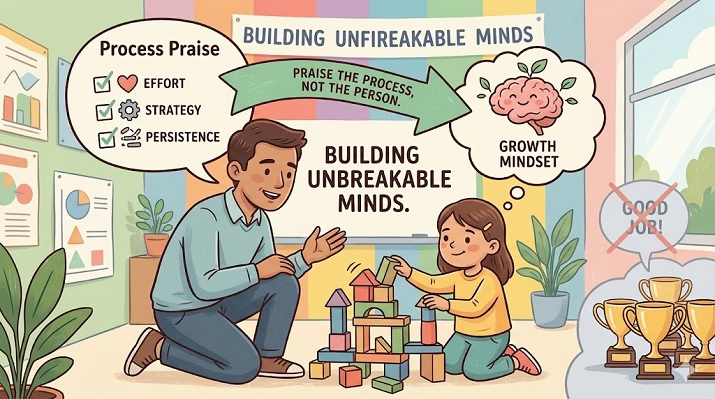
The "Good Job" Trap: Rewording Praise to Build an Unshakeable Growth Mindset
You are sitting at the kitchen table, chopping onions for dinner. From the corner of your eye, you watch your seven-year-old child coloring a picture. They are working hard, their little tongue sticking out slightly as they move a bright green crayon up and down. They finish, wipe their hands on their shorts, and run over to you with a proud smile. They hold up the paper. It is a drawing of a tree, but the green color has spilled way past the dark lines, and the trunk is a bit crooked.
Your heart melts. You want to make them feel amazing. So, without even thinking, you smile warmly and say the same two words you have said a thousand times before: "Good job, sweetie! That is beautiful!"
Your child beams, drops the paper on the counter, and runs off to play. You feel good. They feel good. It seems like the perfect parenting moment.
But what if I told you that those two innocent words—"Good job"—are secretly a tiny, invisible trap? What if saying them over and over again is actually making your child afraid of making mistakes? It sounds strange, doesn't it? How can praise, which comes from a place of pure love, cause harm?
Today, we are going to look under the surface of the words we use every day. We are going to see how standard, empty praise can accidentally build a invisible wall around our children's minds, making them stop trying new things. Then, we will learn how to rewrite our words so we can give them a gift that lasts forever: an unshakeable mind that loves a good challenge and is never, ever afraid of a little failure.
The Hidden Danger of the "Good Job" Habit
Let us think about a tall, sturdy ladder. When we tell a child, "You are so smart," or "Good job, you are the best painter," we are placing them at the very top of that ladder. They look down, and it feels high and scary. They think to themselves, Wow, Mommy thinks I am perfect. She thinks I am a natural genius.
But then, a few days later, they try to build a tower out of wooden blocks. The tower wobbles and crashes down. They try again; it crashes again. Suddenly, a cold feeling of fear enters their little heart. They look at the fallen blocks and think, Oh no. I can't do it. If I can't build this, it means I am not smart anymore. Mommy won't think I am a genius.
To protect themselves from falling off that high ladder of praise, the child decides to do something sad: they stop trying. They only want to do things they already know how to do perfectly. They choose the easy puzzle they have done ten times instead of the new, harder puzzle. They become risk-averse. They avoid the risk of looking foolish because their identity has been tied to being perfect, not to the effort of learning.
When we praise the result (the perfect grade, the beautiful drawing, the winning goal), we accidentally teach our children that we only value the trophy at the finish line. We do not teach them to love the long, dusty run it takes to get there.
Shifting from the Trophy to the Blueprint
So, what do we do instead? Do we stop praising our children completely and become cold and silent? Absolutely not! The secret is to shift our eyes away from the trophy and look closely at the blueprint—the strategy, the sweat, the focus, and the choice to keep going when things get tough.
Scientists who study the brain call this building a Growth Mindset. A child with a growth mindset believes that their brain is like a muscle. They know that when a math problem is hard, or when they can't balance on their bicycle, that frustration is actually the sound of their brain muscle growing stronger. To them, failure is not a heavy stop sign; it is just a bend in the road that says, "Let us try a different way."
To build this kind of mind, we need to change our praise from a generic judge's score into a descriptive camera. Instead of judging the final product, we simply describe the hard work we saw happening.
Let us look at three common situations where we can trade the "Good Job" trap for life-giving, resilient words.
Situation 1: The Art Creation
Your child brings you a painting. It is a bit messy, but they spent forty minutes working on it without looking at a screen.
-
The Old Trap Way: "Wow, good job! You are the most talented artist in the whole world!" (The child learns: I must always make beautiful art to be loved.)
-
The New Growth Way: "Look at all those bright red lines! I saw you sitting at the table for a very long time, working on that corner. You didn't give up even when the paint spilled a little bit. How did you choose these colors?"
Why this works: You are acting like a mirror. You are showing them that you noticed their focus and their patience. You are asking them about their choices, which makes them feel like a real thinker, not just someone waiting for a gold star.
Situation 2: The School Test
Your child comes home from school and holds up a spelling paper with a high mark or a big red smiley face at the top.
-
The Old Trap Way: "Good job! You got an A! You are so naturally smart at words!" (The child learns: If I get a B next time, it means I am stupid.)
-
The New Growth Way: "You worked so hard practicing those tricky words on Thursday night. Remember how we spelled them out loud while walking to the shop? That practice really helped your brain remember the letters. I am so proud of your hard work!"
Why this works: You are connecting the high mark directly to the practice. The child realizes, I did well because I practiced, not because of a magic trick in my brain. If a test is hard next time, I just need to change my practice strategy.
Situation 3: The Sports Field
Your child is trying to kick a football into a small net in the yard. They miss five times, but on the sixth try, the ball flies straight into the net.
-
The Old Trap Way: "Good job! You are a superstar player! You score every time!" (The child learns: If I miss a goal during a real game, I am a failure.)
-
The New Growth Way: "The first few times, the ball went too far to the left. But then I saw you change the way your foot was stepping on the grass. You adjusted your body and kept trying until it went in. That was a fantastic strategy!"
Why this works: You are highlighting their flexibility and problem-solving. You are teaching them that missing the net five times was just data—information their brain used to make the sixth kick work perfectly.
The Magic Word: "Yet"
If you only carry one single tool away from this article today, let it be this tiny, beautiful three-letter word: YET.
Children often use very heavy, permanent words when they are frustrated. They will drop a pencil, heavy tears forming in their eyes, and say:
-
"I can't do this math."
-
"I don't know how to tie my shoes."
-
"I am bad at reading."
These sentences feel like big concrete walls. They sound like the end of the story. Your job as a parent is to step in gently, pick up the pencil, and place that magic word right at the end of their sentence like a golden key that opens a closed door.
-
When they say, "I can't do this math," you whisper, "You can't do this math... yet."
-
When they say, "I don't know how to tie my shoes," you remind them, "You don't know how... yet. But your hands are learning every day."
"Yet" changes everything. It acknowledges that the present moment is hard, but it promises that the future is wide open for growth. It tells the child that learning is a long, beautiful journey, and they are just on the first few steps of the road.
Your Daily Practice Guide
Changing the way we talk is hard. It takes time to erase the old "Good Job" habit from our own tongues. To help you start tonight, use this simple table as a cheat sheet on your kitchen fridge.
| When your child shows you... | Stop saying... | Start saying... |
| A cleaned bedroom | "Good job, you are a perfect helper." | "Thank you! Look at how neat the floor looks now. It is much easier to walk in here without tripping." |
| A song they learned on a whistle | "You are a musical genius!" | "I love listening to that tune. You practiced that high note three times until it sounded just right." |
| A block tower that fell down | "Oh don't worry, it was a silly tower anyway." | "Ooh, look at that big crash! The bottom blocks were too small to hold the heavy top. What can we try next?" |
Giving the Gift of Resilience
Dear parent, take a long look at your child tonight when they are fast asleep, their little face peaceful under the blankets. Think about the world they will walk into when they grow up. They will face big challenges. They will try out for jobs they might not get. They will start projects that might fail.
We cannot protect them from the hard things of the world. We cannot smooth down every rough road before their feet walk on it. But we can build their inner armor.
By changing our praise today, we stop feeding their vanity and start feeding their courage. We teach them to look at a mistake not as a scary monster, but as a friendly teacher. The next time they hold up a messy, colorful drawing or tell you about a hard day at school, smile with your whole heart, look past the final product, and praise the beautiful, messy, wonderful effort inside. That is how we raise children who can never be broken by failure—because they know they are always growing.
Admin
Comments (0)
Join the conversation! Login to leave a comment.
No comments yet. Be the first to share your thoughts!