
Imagine you are sitting on the floor of your living room. The sun is shining through the window, making a warm yellow square on the rug. Your sweet little child is playing right there with a small red plastic cup. Everything is quiet. Everything is peaceful. You take a slow, deep breath, feeling happy. Then, in one tiny second, the world turns upside down.
Your child tries to stack a blue cup on top of the red one. It wobbles. It falls. Suddenly, a loud scream tears through the quiet room. The little body goes stiff as a wooden board. The eyes squeeze shut, and tears start pouring down like a heavy rainstorm. The red cup is thrown across the room, hitting the wall with a sharp bang. Your heart starts beating fast. Your chest feels tight. You ask yourself, What just happened? Why is my baby so angry over a little plastic cup?
We have all been there. It makes you feel like you are failing. It makes you feel like a bad parent. But today, I want you to drop all that heavy guilt. Let it go right now. Your child is not being bad, and you are not doing a terrible job.
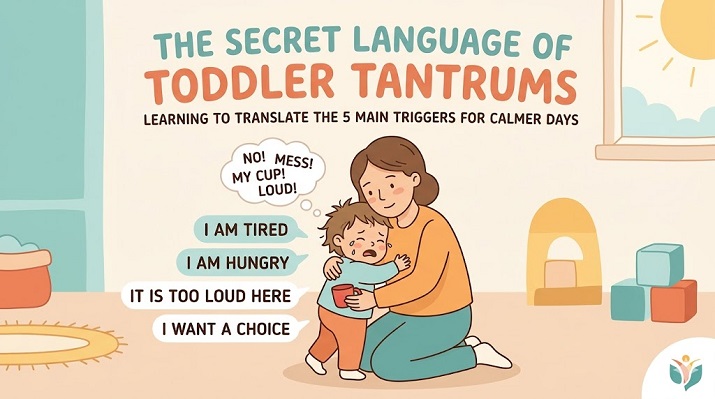
Children do not have big words yet. They cannot sit down, cross their legs, look you in the eye, and say, "Dear Mother, I am feeling very tired because we stayed too long at the market, and the loud music there made my head hurt." They do not know how to say that. So, instead of using words, their bodies use screams. A tantrum is not a fight against you. It is a loud cry for help written in a secret language. Today, we are going to learn how to read that language together. We will look at five secret things that cause these big storms, and we will learn exactly what to say to bring the peace back into your home.
Trigger 1: The Battery is Dead (The Body Energy Drain)
Let us think about your mobile phone for a moment. You use it to make calls, you check on your friends, and you watch a few videos. As you use it, the little green bar at the top of the screen starts going down. It changes from green to yellow. Then it turns red. If you do not plug it into the wall, the screen just goes black. It dies.
A young child is exactly like that mobile phone, but they do not have a red light to warn you. When they wake up, their body battery is full. They run, they jump, they laugh, and they explore. But every single movement drains that battery. Every sound they hear eats a little bit of their power.
By the afternoon, or right before dinner, that battery is sitting at one percent. The child does not know how to tell you, "My body is out of gas." They just feel a strange, uncomfortable sinking feeling inside their chest and limbs. Their small brain cannot handle that feeling. So, the system shorts out. A huge explosion happens.
When this happens, you might try to offer them their favorite sweet treat or show them a colorful cartoon to make them stop crying. But nothing works. Why? Because you cannot fix a dead battery by putting a pretty sticker on the screen. The phone needs the charger. The child needs rest.
What to say right then:
Do not shout. Do not tell them to stop crying. Instead, drop your body down low so your eyes are level with theirs. Keep your voice as soft as a gentle evening breeze and say:
"Your bones feel very heavy right now. Your body is tired. Come, sit near me. We can just be quiet together."
Trigger 2: The Fire Inside the Tummy (The Hidden Hunger)
Have you ever felt your stomach make a angry rumbling sound when you have not eaten all day? It makes you feel grumpy. It makes you lose your patience quickly. Adults know how to walk to the kitchen, find a piece of bread, and fix the problem.
But a three-year-old child does not understand the connection between the empty feeling in their stomach and the angry feelings in their head. To them, the whole world just feels dark and bad. They feel a hot, sharp fire inside, and they think the world is ending.
This kind of tantrum usually happens very fast. One minute they are smiling, and the next minute they are rolling on the floor because you cut their banana into round circles instead of long sticks. The banana shape is not the real problem. The real problem is that their blood sugar has dropped straight to the floor, and their brain is starving for fuel.
If you try to argue with them about the shape of the banana, you will lose. You cannot use logic to fight an empty stomach. You have to feed the fire to put it out.
What to say right then:
Do not ask them questions like "What do you want to eat?" A confused, hungry brain cannot make choices. Just hand them a small piece of food they like, hold your hand out, and say:
"The belly is lonely. It wants some food. Let us take one tiny bite together, very slowly."
Trigger 3: The World is Too Loud (The Mind Traffic Jam)
Close your eyes and imagine standing in the middle of a very busy market. Cars are honking their horns loudly. People are pushing past your shoulders. Three different music systems are playing different songs at the same time. The sun is beating down hot on your neck. You are trying to carry four heavy bags, and someone keeps pulling on your clothes. You would want to scream and run away, right?
Our children live in a world that often feels just like that busy market. Their brains are brand new. They do not know how to block out background noise. When you take them to a big family party, a crowded shopping mall, or even a room with a loud television, their little minds get flooded.
Think of it like a narrow road with too many big trucks trying to pass at the same time. Everything gets stuck. A massive traffic jam forms inside their head. The brain gets so full of sights, smells, and sounds that it simply cannot take one more thing. When you ask them to put on their shoes, that simple request is the final truck that crashes the whole road.
They are not throwing a fit because they hate the shoes. They are throwing a fit because the room is too loud, the lights are too bright, and their mind is completely jammed.
What to say right then:
Take the child out of the busy room. Move into a quiet hallway, a bedroom, or even go outside under a tree. Wrap your arms around them like a warm blanket, breathe in and out deeply so they can feel your chest moving, and whisper:
"It is too loud here. Too many things are moving. I will hold you right here where it is quiet and safe."
Trigger 4: The Word Jail (The Locked-Up Thoughts)
This is perhaps the most heartbreaking trigger of all. Your child has a mind that is full of big ideas. They see a bird outside, and they want to tell you about the beautiful wings. They want to tell you that they want the blue cup, not the green one. They want to tell you that the tag on the back of their shirt is scratching their skin like a sharp thorn.
But their mouth cannot find the tools to build those sentences. The words are locked up inside a dark room in their mind, and they cannot find the key.
Imagine being dropped into a strange country where nobody speaks your language. You are thirsty, but every time you point to the water, people hand you a book or a shoe. You would get angry. You would stamp your feet. You would feel deeply frustrated because nobody is listening to your heart.
When a toddler realizes they cannot make you understand what they need, they feel trapped inside a word jail. The only way they can break the bars of that jail is to use their voice as a hammer. The scream is their way of saying, Please, just listen to me! Try harder to understand me!
What to say right then:
Touch your hand to your own heart, look at them with soft, kind eyes, and say:
"The words are stuck inside today. It is hard when I don't understand. I am listening with my eyes now. Show me with your hand."
Trigger 5: The Loss of the Steering Wheel (The Scared Mind)
As adults, we decide everything. We choose when to wake up, what clothes to wear, what food to cook, and when to go outside. We hold the steering wheel of our lives completely.
Now, look at the world from your child's knees. They are tiny. They are told when to sit, when to stand, when to wash their hands, and when to leave the playground. They have zero control. It feels like riding in a fast car where a stranger is driving, and you have no idea where you are going. That can feel very scary.
Every now and then, a child needs to feel like they own a tiny piece of the world. They want to hold the steering wheel, even if it is just for five minutes. If they feel like they have no choices at all, they will find a way to make a choice. And often, that choice is to stop moving, sit on the floor, and refuse to do anything you ask.
This is not a battle of power. It is a small, frightened soul trying to find a little bit of safety in a world that feels much too big and bossy.
What to say right then:
Give them back a little bit of the steering wheel. Do not command them. Give them two simple choices where either choice is fine with you. Kneel down and say:
"You want to choose right now. We need to leave, but you can choose: Do you want to wear the blue hat or the red hat today? You decide."
Your Everyday Peace Plan
Now you know the five secret triggers. You have the keys to the language. But knowing the triggers is only half the battle. What do you do when the storm is raining down right in front of you? How do you keep your own heart calm when the neighbors might be listening to the screaming?
Let us walk through three simple steps to guide your family through any tantrum storm, using love instead of anger.
Step 1: Secure Your Own Anchor
When a ship is caught in a wild ocean storm, it does not throw wood into the waves to stop them. It drops a heavy iron anchor deep into the mud at the bottom of the sea. The anchor stays still, no matter how hard the wind blows.
When your child starts to scream, your own body will want to get angry. Your face will get hot. Your voice will want to rise. Stop. Take one long, slow breath through your nose. Hold it. Let it out through your mouth.
Tell yourself inside your mind: My child is having a hard time, not giving me a hard time. You must be the anchor. If you get angry too, you are just throwing more wind and waves into the storm. Two angry people cannot create a peaceful room.
Step 2: Clear the Space
If your child is kicking and waving their arms, gently move away any hard toys, sharp chairs, or objects that could hurt them. Do not try to drag them across the room unless they are in danger. Just make a safe circle around them.
Do not try to teach them a lesson right now. A child who is crying heavily cannot learn anything. The learning part of their brain has completely shut down for the moment. Trying to talk about good manners during a tantrum is like trying to teach someone how to swim while they are drowning. Just focus on keeping them safe.
Step 3: Use the Bridge of Touch
Some children want to be held tightly when they are upset. Others feel trapped if you touch them while they are angry. You know your child best.
If they do not want to be held, just sit on the floor two steps away. Keep your hands open and relaxed on your knees. This shows them that you are not going away. You are not leaving them alone in the dark with their big feelings. You are waiting right there at the edge of the storm, ready to welcome them back when the wind stops blowing.
A Final Message for Your Heart
Dear parent, please remember this truth when the days feel long and the nights feel weary: Tantrums are not a sign that your child is spoiled. They are not a sign that you are a weak or bad mother or father.
These years are very short, even though the days feel like they last forever. Your child's brain is growing every single day, building new pathways, learning how to handle this big, loud world. Right now, they are leaning on your strength because their own inner strength is still small.
The next time a tantrum starts, do not see it as a fire to fight. See it as an invitation to show your child that your love is bigger than their biggest mistake. You can do this. Take a deep breath, lower your voice, and use the secret language of love to bring your baby back home to peace.