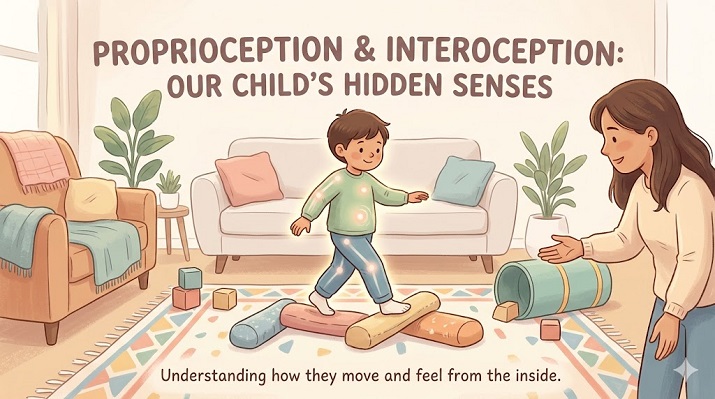

Have you ever watched your young child walk down a straight, open hallway and suddenly bump right into the wall? There is nothing on the floor. No toys to trip over, no slippery water, and the lights are fully turned on. Yet, they crash into the side of the wall like a tiny, clumsy ship hitting a big rock. You might laugh softly and say, "Oh, watch where you are going, little one!" But inside, you might wonder why their feet seem so unsure of the ground.
Or maybe you have seen something else that makes you worry. It is late afternoon, and your child is running around the room like a wild wind. They are shouting, throwing cushions, and hitting their own knees. You ask them, "Does your tummy hurt? Do you need to use the toilet?" They scream, "No!" and keep running. Then, just five minutes later, they have an accident on the floor, or they suddenly sit down and burst into heavy tears because they are completely starving.
When these things happen, it is very easy to feel frustrated. You might think, Why aren't they listening to their own body? Why can’t they just sit still?
Today, we are going to open a secret door inside the human body. We all know about the five basic senses we were taught when we were young: sight for seeing, hearing for listening, smell for noses, taste for tongues, and touch for fingers. But did you know your child has two more hidden senses? They are like secret internal maps that live deep inside the muscles and organs. Doctors call them "proprioception" and "interception," but we can just call them the Body Map Sense and the Inner Feeling Sense." Let us discover how these two hidden senses work, why they cause so many strange behaviors, and how we can help our children build them up through simple, joyful games.
Hidden Sense 1: The Body Map Sense (Proprioception)
Imagine you are lying in bed at night. The room is completely pitch black. You cannot see your own hands or feet. If I ask you to touch your nose with your right index finger, can you do it? Yes, you can! You do not need a mirror, and you do not need a flashlight.
How does your arm know exactly where to move in the dark? It is because of your Body Map Sense. Deep inside every single muscle, joint, and bone in your body, there are millions of tiny, invisible sensors. These sensors constantly send urgent letters to the brain, saying: "The right arm is bent. The finger is moving up. The nose is right here." This sense tells your brain exactly where your body parts are without you having to look at them.
Now, think of a young child. Their body map is still being drawn. It is like a rough sketch on a piece of paper, not a clear photograph. For some children, the map is very blurry. Their brain cannot easily tell where their arms and legs end and where the rest of the world begins.
This is why they crash into walls. It is why they drop their cup of milk on the table because they misjudged how far away the wood was. They are not being careless or bad. They are literally trying to find their place in space. When they run fast, bump into furniture, or stomp their feet heavily on the floor, they are actually trying to push hard against things so their muscles can send a stronger signal to a sleepy brain. The bumping is their way of waking up the body map!
The Signs Your Child's Map is Blurry:
They press down so hard with their pencil that the tip snaps instantly.
They prefer to jump and crash onto the sofa instead of just sitting down.
They walk into people or objects quite often.
They hug friends or pets much too tightly, not realizing their own strength.
Hidden Sense 2: The Inner Feeling Sense (Interoception)
Let us take a trip inside the body now, away from the muscles and into the dark, quiet spaces where the heart beats and the stomach lives.
As an adult, when your heart starts beating very fast, your brain instantly reads that signal. It tells you, You are scared, or You are running too fast. When your throat feels dry, your brain says, Go drink water. When your bladder feels full and heavy, your brain says, Walk to the bathroom right now. This internal communication line is called the Inner Feeling Sense.
But for a small child, this communication line can have a lot of static noise on it, like an old radio that cannot find the right station.
When a child has a sleepy Inner Feeling Sense, they cannot read the whispers of their own organs. A full bladder does not feel like a clear signal to go to the toilet; it just feels like a strange, confusing pressure that makes them feel anxious and restless. They do not know what the pressure means, so they start running around or throwing toys to escape the uncomfortable feeling. They only realize they need the toilet when it is already too late and the water is on the floor.
The same thing happens with hunger. They don’t feel a gentle hunger pang. Instead, they just suddenly feel a massive wave of anger or sadness because their blood sugar dropped, but they have no idea that a piece of bread would fix it. They are locked outside the house of their own feelings.
The Signs Your Child's Inner Line is Sleepy:
They do not seem to notice when they are wet or soiled until long after it happens.
They say they are not hungry, but then they eat a huge meal ten minutes later.
They have a very high tolerance for pain; they fall, scrape their knee, and just get up without crying.
They find it very hard to tell you if they are angry, sad, or just tired—everything just looks like a giant explosion.
Three Simple Games to Clear the Blurry Map
The wonderful news is that these two hidden senses can be exercised and strengthened just like a weak muscle! You do not need expensive therapy tools or complex doctor visits. You can turn your living room or yard into a sensory playground using things you already have at home.
Let us look at three simple games that will help your child sharpen their Body Map Sense so they can stop crashing and start moving with confidence.
1. The Heavy Log Carry
Muscles love heavy work. When a child carries something heavy, it presses their joints together, which sends a bright, clear message straight to the brain's map.
How to play: Gather a few large plastic bottles and fill them with water or sand. Tell your child that they are a strong builder or a brave forest worker. Ask them to carry the heavy "logs" from one side of the room to the other to build a secret fort. Watch how calm and focused their face becomes as their muscles finally get the heavy feedback they crave.
2. The Blanket Burrito
This is a beautiful, soothing game for the evening when the child is feeling wild or disorganized.
How to play: Spread a soft, clean blanket on the floor. Have your child lie down at one edge of it. Slowly and gently roll them up in the blanket, keeping their head completely free so they can see you and breathe easily. Ask them, "Is this a cozy burrito?" Then, give gentle, firm presses with your hands all along their arms, torso, and legs, like you are patting down dough. This deep pressure gives their brain a clear outline of exactly where their body begins and ends, melting away anxiety.
3. The Animal Walk Safari
This game forces the brain to coordinate different body parts at the same time, filling in the blank spots on their physical map.
How to play: Call out different animals and act them out together across the room. Do the "Bear Walk" (hands and feet on the floor, hips high in the air), the "Crab Walk" (sitting on the floor, lifting the bottom up, and walking backwards on hands and feet), or the "Frog Jump" (squatting low and exploding upward). It is full of laughter, but it is secretly doing deep, serious brain wiring work.
Two Quiet Rituals to Wake Up the Inner Feelings
To help your child connect with their internal organs, we need to slow things down and help them listen to the quiet whispers inside. Here are two gentle routines you can start doing today.
1. The Heartbeat Stop
This ritual connects physical movement to inner emotion, teaching the brain to read the heart's speed.
How to play: Have your child jump up and down or run in place as fast as they can for thirty seconds. Then shout, "Freeze!" Put your hand over your own heart and have them place their little hand right over their own chest. Sit in total silence for ten seconds and just feel the thump-thump-thump against their fingers. Say softly, "Listen to your heart. It is running fast because you ran fast. It is calming down now." This teaches them that what happens on the inside is connected to what they do on the outside.
2. The Tummy Weather Report
Instead of asking your child, "Are you hungry?" or "Are you upset?", which can feel too big and abstract, change the language to something visual and simple.
How to use it: Ask them to give you a "Weather Report" for their stomach. Is it sunny and quiet inside? Is there a stormy, rumbly cloud waking up? Is it heavy like rain? By using simple words like hot, cold, heavy, tight, or loose, you help them build a bridge between physical sensations and emotional words before an explosion happens.
A Note of Patience for Your Journey
The next time your child knocks over their water glass for the third time in a row, or the next time they wait until the very last second to run to the bathroom, take a long, slow breath. Drop the thought that they are doing it to annoy you.
Their inner world is still under construction. They are travelers trying to learn how to drive a beautiful, complex machine—their own body—without an instruction manual. By playing these simple games and using patient, descriptive words, you are helping them draw a perfect, clear map of their own physical form. You are teaching them how to feel safe, steady, and peaceful inside their own skin. Turn off the worry, open up the play, and enjoy watching your child connect with their hidden senses day by day.